The Laiki

the_laiki_aegean_adventures

If you hang around Athens long enough you’ll eventually hear the word laiki.

-I couldn’t find any cauliflower at the laiki today.
-Don’t buy those green peppers. The laiki is tomorrow.
-Aren’t these curtains cute? I got them at the laiki!
-I buy all of my fish at the laiki.
-Toilet paper is cheaper at the laiki.

So, what’s the laiki? (Pronounced lie-KEY)

It’s a farmer’s market with a just a touch of a discount store.

While seasonal fruits and vegetables are the main items you’ll also find fish, napkins, toilet paper, inexpensive kitchen utensils, mops, sponges, and even traditional incense and charcoal if you want your home to smell like the inside of an Orthodox church.
laiki_aegean_adventures

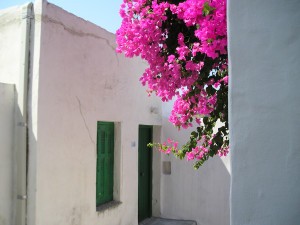
Every neighborhood in Athens has its own laiki day when all cars are banned and the street teems with housewives and their small, wheeled shopping carts overflowing with fresh produce.

Visitors staying in Athens for several days should ask around and see if they can find a laiki nearby their hotel. It’s a truly local experience.

0 Read More

Rowing an Ancient Greek Trireme

Rowing an Ancient Greek Trireme by Colleen McGuire, July 26, 2017

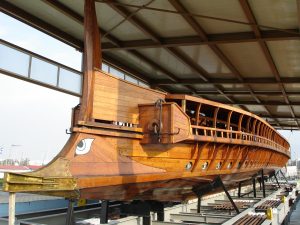
For a fleeting moment this summer, I had the opportunity to inhabit the role of an ancient Greek sailor.   For three euros, the modern Greek Navy gave me and about 170 other fantasizers the chance to be a rower on the Olympias, a reconstructed trireme 37 meters long (122 feet).     

A trireme was a seagoing vessel used by the Greeks in the 7th to 4th centuries BC as a fast and agile warship.   The Olympias was built in the 1980s based on detailed discussions with history, literature and archaeology experts to approximate a true trireme.  However, the actual materials used for the Olympias were presumably inaccessible to Mediterranean boat builders  — Oregon pine, Virginia oak and iroko, a teak-like wood from tropical Africa used for the keel.

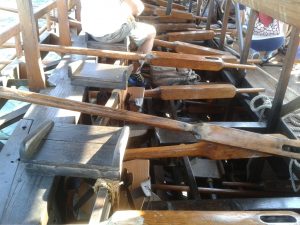
Triremes are propelled by three tiers of oars on both sides with an upper seat, middle seat and lower seat.   I scrambled for an upper seat on the Olympias which offered a full view of the sea.  Late-comers were relegated to the bottom tier with no views and no breeze.  I imagined those seats were once reserved for the slaves.  Yet, on researching triremes, I learned that the ancient navies were composed only of free men by which many, particularly working class Athenians, could fulfill their military service obligations.   Foreign mercenaries were also aboard, but no slaves, except in emergencies, and then they were set free before employment.

It was a little awkward reaching my “window” seat, bending low and stepping over and between long wooden oars.   Perched on a square piece of wood, I placed my feet on what looked like inverse starting blocks for sprint races with leather straps to lace up.  For serious rowers these foot things probably served the same purpose as toe clips do for cyclists.

There were approximately 170 of us rowers on this sunny late afternoon, plus a number of young kids allowed to sit in the aisles next to their parents.  We were a pretty pathetic crew with no prior training and next to no instructions.  When the captain yelled “ena” (one), you hovered your oar over the water.

When he yelled “dio” (two), you dropped the oar and pulled it towards you through the water.   Sounds simple enough but humans are not ants or bees who instinctively know how to work in unison.  Our group rowed as if each of us were alone in our own private rowboat oblivious to what the others were doing. The vertical tiers of oars kept colliding with each other which resulted in putting the vessel way too close to the jetty.    I felt a little sheepish when a Navy motor ship had to rescue the Olympias and tow us out to the open sea.

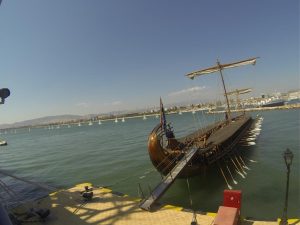
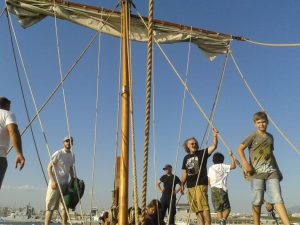
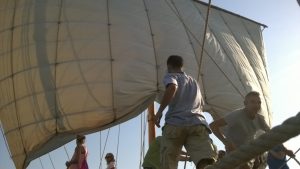
Once in the Argo Saronic waters, the real crew (the Navy) rose the two masts.  I regret I didn’t make an effort to struggle out of my seat to go up to the deck as surely those two sails must have been a beautiful view.    In the open waters with nothing around for miles, we practiced our moves and actually began to achieve a modicum of group coordination.  By the time we got back to port the crew was rowing in earnest harmony.     It was a truly a unique experience.
The Olympias is docked full time in dry dock at Flisvos Marina along with other historic ships in the open air museum known as Naval Tradition Park.   This trireme replica is the only commissioned vessel of its kind in any of the world’s navies.


Read More

Santorini’s Wine Harvest

The island of Santorini resulted from a violent volcanic eruption millennia ago. Consequently, the earth is gray or black volcanic ash and looks dead. But, the ashen lava is the secret ingredient of Santorini’s wine success. The Cycladic vine is circular and lies in a depression in the ground to protect it from the strong Aegean winds. New shoots are woven around the stump in the shape of a basket or wreath, a clever technique allowing water, a scarce item on Santorini, to collect from nocturnal fogs.

Click here to read a personal account about picking grapes in Thirasia with Pappou in August, 2008 by Colleen McGuire

0 Read More
There is no substitute for hard #work. #JupiterV5 is on the way!

There is no substitute for hard #work. #JupiterV5 is on the way! @artbees

What to do with Pangrati Woods?

pangrati_woods_aegean_adventures

In the center of one of Athen’s most densely populated neighborhoods is the little oasis of Pangrati Woods.

Inside the Woods it’s easy to forget the choking traffic that has come to typify modern Athens. In a city with only 2 square meters of green space per resident the winding pathways, picturesque stone steps and tall trees take the visitor away, even if momentarily, from the stress of city life.

The City of Athens has proposed a revitalization plan for the inner city green space that has spawned strong opinions both for and against the project.

While Athens Mayor Nikitas Kaklamanis believes in the plan to uprade the parks lighting and open a cafe and an outdoor theater, others aren’t too pleased with the idea, arguing that a cafe and a cinema would only add more concrete to Athens. Professor Eleni Portaliou believes that the…

…parks and woods are natural oases, small ecosystems within the city and should not be burdened with facilities that attract large crowds.
(Athens Plus, November 14, 2008)

It is true that in 1928 the park was host to both an open-air theater and a small zoo.

However, the Athens of 2009 is not the Athens of 1928.

Read More

Thessaloniki Film Festival 2017

film_festival_aegean_adventures

Faithful to its established annual appointment, the 58th Thessaloniki International Film Festival will take place April 2017. With renewed vision and a strong dedication to independent cinema, the Festival will once more invite both film makers and the audience to a special celebration of film. Films from all over the world, cinematic surprises, distinguished guests, tributes, masterclasses, round table discussions and parallel events will comprise the ten-day event.

Each year close to 300 independent films from around the world (in a variety of genres) are presented. The films are judged by a distinguised panel of judges and there are awards given. The festival is considered an international event and past judges have included Francis Ford Coppola and Faye Dunaway.

Over the years the festival has attracted many parallel, non-film events such as concerts and art exhibitions, thereby making it a perfect destination for clients who have an interest in the arts.

The Thessaloniki Documentary Film Festival takes place March 3-12, 2017.

0 Read More

Slow Motion Travel on Lesvos

Skala EressoBy Colleen McGuire

An ancient mystique is one ingredient luring me to a foreign land. The island of Lesvos proved bewitchingly alluring, not least because it is home to the oldest known female poet in history, Sappho, born in 628 BC in the town of Erassos. A second beckoning ingredient is a land’s potential for adventure travel, and Lesvos delivers on this count.

Also known as Mytilini, Greece’s third largest island has a network of at least 400 miles of well-maintained paved roads. With my Trek 1220, two panniers and a tent, I spent two weeks bicycling to just about every town and village in the island accessible by asphalt. With great relief, I hereby broadcast that as a single female traveler, I was never once harassed, disturbed, or pestered by any man.

Although Mytilini with roughly 90,000 inhabitants certainly has its share of foreign visitors, compared to Cyclades islands such as Santorini and Mykonos, its tourism falls short of industry proportions. There are pockets of tourist activity where mostly northern Europeans cluster, yet more common are the countless empty beaches that render bikinis cumbersome. I slept on many such beaches, my tent pitched within spitting distance of the Mediterranean.

OLYMPUS DIGITAL CAMERA

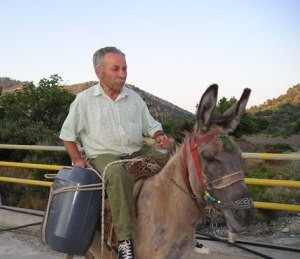
The twelve-hour overnight ferry from Athens deposited me in the capital, Mytilini, at 8:00 in the morning.  Upon touching terra firma, I set off cycling up the island’s eastern flank taking a leisurely pace to check out several monasteries or marvel at the tantalizing views of Turkey, a mere two hour boat ride away.  The silence of a lone highway was often startlingly ruptured by a clamorous clink-clank-clink of metal bells dangling from a herd of twenty or so goats.  The click-clack of old men riding donkeys side saddle is also a frequent sight for a road cyclist.

By 6 p.m. my first day, 40 miles later, I arrived to the adorable fishing village of Skala Sikaminias where I camped for the night.  Its parent town, Sikaminias, is two steep miles away, comprising maybe 900 inhabitants.   When summer comes many of the villagers of Sikaminias move down to Skala Sikaminias, and when summer ends, they ascend back up the mountain. I was told about this unique seasonal movement by a resident of Eressos and Skala Eressos.  She said that until only four years ago for decades her entire village — including merchants, doctor, pharmacy, post office — made its annual mountain-sea-mountain relocation en masse on the very same day.

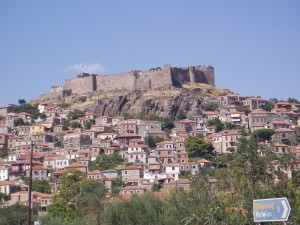
From Skala Sikaminias, I traveled about ten miles westward on a gravel road hugging the sea to photogenic Molyvos, (population about 1400), a town which under no circumstances can be missed.  Its winding, narrow cobblestoned streets and elegant stone houses with loudly painted shutters set against the blinding blue sea and an imposing castle make Molyvos a destination for the romantically inclined.
OLYMPUS DIGITAL CAMERA

OLYMPUS DIGITAL CAMERA

On that rocky coastal road to Molyvos I came across hot springs that are not “tamed” so to speak, meaning no one has enclosed them. They are just out there in the sea, no building, no sign, no fees, no people. You wouldn’t even know to look for them except that I got a “heads-up” from a local dispensing sketchy, but correct instructions – look for steam arising out of the sea near a white boat and a big rock not far around the bend. I sat in bliss in hot water rising from the earth, my back resting against a smooth rock, savoring the tingling feeling of cool sea waves lapping over me.

About three kilometers from Molyvos is a more formal hot springs called Eftalou. The antiquated spa is a little structure with a round white roof, a hammam as it is called in Turkish, that is a popular tourist site famed for its natural healing capacities. The place was closed on a Sunday morning, but I went behind the building and sat directly in the hot sea water

I visited many mountain villages of 200 or 300 residents, places like Pterounda or Ambelika or Pelopi whose Dukakis Street is named for a certain American because this is his ancestral home. These are towns by and large ignored by European vacationers since the beach is their premier attraction. Each village has a little plateia (square), usually with a vine-covered canopy for cherished shade. Mandatory are several coffeehouses, called kafeneions, where the men sit for hours drinking thick Greek coffee from doll-sized white demitasse cups, “Mavro,” they’d order (black).

I would bicycle into a village, often turning a narrow corner, suddenly appearing into the plateia rather dramatically from nowhere in stark contrast to the noisy announcement of a car or motorcycle. I was invariably told that I was the only bicyclist in memory to ride into town. My presence always created a hubbub and soon the routine litany of questions would begin in this order: Where are you from? Where is your husband? Do you have any children?

OLYMPUS DIGITAL CAMERA
After a while, I would leave the center of gravity of the town, the plateia where the men dominated, and start venturing down the village’s side streets where the women prevailed. I would find them at home, sewing, cooking, relaxing on porches, or tending to animals. Young and old, seemed dazzled by my female presence on a bike. “All alone?” the women always asked in seeming admiration. A glass of water, fruit, a towel to wipe my sweat were offered to me when I visited women in their homes. I was never looked at suspiciously or with a glare of distrust. A smile always greeted my smile, coupled by direct and forthright eye contact.

The shape of Lesvos can be likened to an upside-down uterus with the Kalloni Gulf marking the dividing line between the verdant, watery east and the dry, arid west. Helpful to a cyclist, even in the barren west, is the ubiquity of potable water. Every town has at least one public fountain, and often you find running water in the middle of absolutely nowhere and refreshingly cold. While cycling in a pulverizing sun which Greeks have sense enough to stay out of, I’d dunk my head under the spigot and the rush it created was enough to keep me cycling until the next fountain.

OLYMPUS DIGITAL CAMERA
This island has many novel surprises, such as, the petrified forest near the western town of Sigri whose “trees” still stand (in contrast to Arizona’s rock-forest all lying on the ground). Migrating birds from Africa make the island an internationally desired venue for birdwatchers. The aromatic pine forest mountains in the south can make a mountain biker delirious, while Kelloni Gulf, looking and feeling like a big lake, offers great windsurfing and is famous for its sardines.

Equally noteworthy is Lesvos’ flora. Near Molyvos I unexpectedly set my tent next to a bush of wild rosemary and I’m certain its heady fragrance infiltrated my dreams for the two nights I camped there. One day on an isolated road I encountered a smiling man (where had he come from?) carrying a little green and lavender sprig. He handed it to me saying, “mentha,” which my dictionary translates as peppermint. I carried the wild twig in my handlebar bag for days, whiffing its energizing scent regularly. In an adorable fishing village, Niferida, an old woman cooked louloudia. This uniquely delicious plate consists of the bright yellow/orange flower of the zucchini plant rolled up in a conical shape and stuffed with rice and herbs. I’d never seen or tasted anything like it.

OLYMPUS DIGITAL CAMERA

Skala Eressos is the epicenter of lesbian visitors from all over the world, many of whom come year after year. Although unmistakably Greek, the town has its own distinct vibe. You find, for example, women casually caressing each other at the hip Sappho Hotel, a nude beach unusually close to the town’s main beach, a taverna named Filomena which serves a daily vegan dish, reflexologists and other healers advertising their arts, a women’s only hotel, anti-war graffiti stating, “Bush, Blair, Sharon = Terrorist.”

If you like ouzo, then head to Lesvos and specifically to the town of Plomari in the south where it was born. There are actually certain brands of ouzo that can only be purchased in Plomari. Just as wineries are to be found in Santorini, ouzo factories invite you in to taste their brand.
OLYMPUS DIGITAL CAMERA

on the road into Skala Eresso


Visitors to Lesvos regard this precious island as one of Greece’s best kept secrets. The people are warm and friendly. The food is divinely delicious in part because Mytilini produces some of Greece’s finest olive oil. There are as yet no high rise hotels or packaged jumbo jets of tacky tourists trampling all over the place. I didn’t meet a single American until I took a day-boat to Turkey at the end of my trip.

For you women adventure travelers on the look-out for a female friendly, mountain-sea locale that offers physical challenges and an unobtrusive charm, Lesvos is waiting to unleash your goddess spirit.

Written July 2003
OLYMPUS DIGITAL CAMERA


Read More

Crete: Sea Kayaking in Spinalonga

crete-2003-019-aegean-adventuresFrom Plaka, a pretty town north of Agio Nikolaos in eastern Crete, the island of Spinalonga looks invitingly close. Just a hop, skip and a paddle away by sea kayak—or so it seemed.

Spinalonga is a spit of land situated at the mouth of Spinalonga Bay. Strategic since antiquity, in 1579 the Venetians erected a gargantuan fortress befitting of their superpower status, and indeed, its protectors defied Turkish conquest for several decades longer than any other Cretan garrison. The fort finally fell to Ottoman rule in 1715.

On a warm October day our energetic group of four Americans and four Greeks sought to kayak over to Spinalonga Island. From there, we would head down its bay, a short portage, then down Poros Bay to Agio Nikolaos. At most, the trip was fifteen kilometers.

From Plaka, a local fisherman can probably make the voyage to Spinalonga Island in about twenty minutes. It took me about two hours.

I should point out that I had never kayaked. My initial hour was spent on land just trying to get a grasp of this sport and its paraphernalia. We donned life jackets, colorful wetsuits and learned how to put on a “skirt.” This is a sturdy cloth worn around your waist: when seated in your kayak, you attach the skirt’s hem to the open perimeter of your seat so that water doesn’t enter the boat. Next were some rudimentary rowing lessons. We sat on the beach, pretending we were at sea, and went through the motions of manipulating the oars.

I reasoned that, being a first-time kayaker, I should buddy up with another novice, Pia, in a two-seater. Wrong. Pia and I didn’t know when to paddle, how to coordinate our rowing or even which direction to face when a strong wind blew. Not but fifteen minutes after setting out to sea, one moment we were dry, the next moment we were wet. The boat capsized so suddenly we didn’t even have a chance to shout the proverbial “Man Overboard!” Sobered by the incident, we took our friends’ advice and got our own kayaks, and discovered that individual navigation was superior to teamwork, at least when the team was clueless in the art of kayaking.

crete-2003-013-aegean-adventures

When I learned that Yiannis capsized in his kayak, too, I was beginning to fear our excursion would match the disasterous pre-Games rowing test events for the Athens Olympics which took place in August, 2003. The new rowing center at Schinias was vulnerable to the maltemia, the summer winds, which created whitecaps and forced Olympic officials to call off the opening day of competitions. Later, winds still dominating, the United States rowing team actually capsized. What a photo that made for the Greek press! Within a day of their arrival the entire German rowing team, heretofore ranked number one, fell ill with food poisoning and immediately retreated back to Germany. I prayed our rowing adventure would not suffer similar afflictions.

Finally, we all made it to Spinalonga Island, some of us quite wet and all of us looking a little goofy in our loudly colored outfits, especially the kayak mini-skirts. The tourists stared, mostly at Miltos. While our skirts laid flat, his undulated with a flamboyant pink hem akin to an Argentine tango costume that got shrunk at the cleaners. For some reason, he kept it on during our visit to Spinalonga which prompted endless guffawing.

After Crete formally united with Greece in 1913, Spinalonga became a leper colony and remained so until 1957. The island is larger than expected when you peer at it from the Crete mainland. One can easily spend several hours strolling its pathways and perimeters. The elegant Venetian architecture—curved arched portals, for example—contributes to Spinalonga’s beauty, yet a haunting feeling pervades, perhaps attributable to the cemetery whose open graves bear the assumingly impaired bones of the prior inhabitants.

My afternoon kayaking was far more successful once I got the hang of it. And the disappearance of the winds helped appreciably. Our group soared along pretty much all together instead of scattered leagues apart as we had been during the morning. The scenery in Spinalonga Bay is breathtakingly spectacular. Mountains in the distance on a blinding shiny blue sea devoid of any other seafarers except the eight of us. The rock cliffs on the coast mesmerized me: they were wavy, in layers, like slabs of thick uncooked bacon stacked on top of one another, truly of postcard caliber. One area we paddled to appeared as if we were sheltered inside a cave, but actually we were in an open area on the sea.

I eagerly recommend sea kayaking in Spinalonga Bay. Beginners can complete the journey from Plaka to Agio Nikolao, with a pit stop on the island, easily in one day. You will feel thoroughly exhilarated by the hearty aquatic workout and gain yet another reason to place Crete at the top of your Magnificent Mediterranean Islands List.

crete-2003-031-aegean-adventures

0 Read More
page 1 of 2
Contact Us

We're not around right now. But you can send us an email and we'll get back to you, asap.

Start typing and press Enter to search